Imagine this: it’s a hot summer day, and you’ve just finished some yard work. You go to grab an ice-cold water from your garage fridge, and it’s completely frozen! If that’s too hard to visualize in this February weather, try this: you go to store your holiday favorites in your back-up basement fridge. On the day of the big feast, you trudge downstairs to find your food thawed and spoiled! Oddly enough, both issues can occur because your second fridge is kept in an uninsulated area and isn't "garage ready." If you’re already asking yourself, “What even is a garage-ready fridge?” You’ve come to the right place. We’ve put together this article to help explain what it means to have a garage-ready refrigerator, and why it’s important to look for this feature when searching for a new model to fit your home’s climate-based spaces.
What Garage-Ready Means
When it comes to placing an appliance in an uninsulated space (like your garage, basement, or workshop), you want to make sure to look for an appliance that is marketed as "garage ready.” This can make all the difference when it comes to the appliance’s performance, longevity, and energy efficiency. Especially when it comes to extreme temperatures in the winter and summer months.
Garage-ready models are built with components that can handle severe temperature fluctuations. Typically, these garage-ready models are tested to operate in temperatures as low as 0°F, and as high as 110°F. Please note that the temperature range varies by manufacturer, so make sure you ask your local Hallocks Sales Team for temperature specifications if you are purchasing a refrigerator for your garage. These units use modified thermostats, stronger compressors, and better insulation to keep the internal temperatures consistent, even when the room temperature fluctuates dramatically. If you have a refrigerator in your garage now that is not garage-ready, you may notice in the frigid cold months that your ice cream is a little bit melted; that’s because the outside temperature “tricks” the thermostat into thinking the refrigerator and freezer compartments are cold enough.
Some manufacturers, like Maytag, specifically engineer certain freezers and refrigerators for garage placement, ensuring your food stays safely frozen or refrigerated no matter what’s happening outside.
Why is this Important?
1. Inconsistent Temperatures
As we’ve explained, traditional refrigerators rely on ambient room temperature to help regulate internal cooling. When the garage gets too cold, the fridge may not run often enough because it “thinks” everything is already cool. In extremely hot conditions, the opposite happens; the compressor must work overtime to maintain safe temperatures. This can cause overheating, premature wear, and higher energy bills.
2. Compressor Strain
In the hot summer months, a non-garage-ready refrigerator will cycle on almost constantly trying to keep up. Over time, the strain on the compressor can shorten the appliance’s lifespan. In the bitter cold winter months, the temperature can cause lubrication issues within the compressor. The garage-ready units are built to handle both temperature extremes, meaning there is no overworking which can help extend the lifespan of the appliance.
3. Safety Concerns
Improper temperature regulation isn’t just inconvenient; it can be unsafe. If your freezer partially thaws and refreezes, food quality and safety are compromised. Though garage-ready refrigerators might be slightly more expensive than the cheapest thing out there, it is important to spend a bit more so you’re not throwing out food that ends up spoiled.
4. Energy Efficiency
When a refrigerator works harder than it’s designed for, it tends to use much more electricity, which can lead to a higher electric bill at the end of the month. With a garage-ready model, you don’t need to worry about consuming any extra electricity as the compressor is designed to deal with the varying temperatures. You can also opt for Energy Star models to save even more on utility costs.
How Can I Tell?
Thankfully, it’s easy to tell if the refrigerator you’re looking at is garage-ready. The first step is checking the specification sheet. Typically, if the unit is designed to be put in an uninsulated area, it will clearly state it on the fridge specifications. If for some reason the specification sheet doesn’t list it, look at the approved operating temperatures. If you see that it is listed from 0°F to 110°F, you’re good to go.
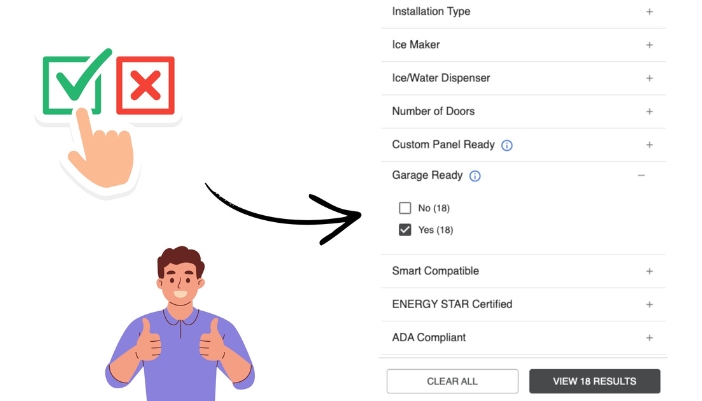
You can also conveniently search for garage-ready rated appliances in the “All Filters” tab on any refrigerator search on our website, like so:
If you’re in store, a dedicated Hallocks team member will be more than happy to help you compare garage-ready options based on your space, budget, and storage needs.
Our Favorite Fridges
We asked our sales team what their favorite garage-ready models are from each brand. Here are a few of our top picks you can find on our website:
GE: 28” 16.6 Cu. Ft. Top Freezer Refrigerator
Model Number: GTS17DTNRWW (White)
Maytag: 30” 19.3 Cu. Ft. Garage Ready Top Freezer Refrigerator
Model Number: MTRX5119SZ (Fingerprint-Resistant Stainless Steel)
Whirlpool: 30” 19.3 Cu. Ft. Top Freezer Refrigerator with Total Coverage Cooling
Model Number: WRTX3119SZ (Fingerprint-Resistant Stainless Steel)
Frigidaire: 30” 18.3 Cu. Ft. Top Freezer Refrigerator
Model Number: FFTR1835VS (Stainless Steel)
The Bottom Line
If your garage, basement or workshop isn’t insulated or climate-controlled, a standard kitchen refrigerator will not cut it. You need a garage-ready refrigerator to keep food from spoiling, maintain the appliance’s lifespan, and avoid higher energy costs. Garage-ready refrigerators are designed to withstand extreme temperature fluctuations, and while the difference isn’t visible from the outside, these distinctions make a huge difference in performance. Remember, before you purchase, check with your local Hallock’s team member to confirm the operating temperature range.
When it comes to garage-ready appliances, the right choice isn’t just about size and style, it’s also about what’s on the inside. Don’t make the mistake of buying an appliance rated for a temperature-controlled location, only to be let down when they don’t perform well in your garage, basement, or workshop. Let Hallock’s help you find the right appliance today!