You can measure the space your new refrigerator is going into ten times, find one that fits perfectly into the space, and still end up with a door that cannot fully open because it hits a wall, cabinet, or other appliance. Trust me, it’s disheartening when that gorgeous new appliance is taking up way too much space.
Don’t worry, though, not all hope is lost!
Zero clearance doors are becoming increasingly popular, especially in counter-depth refrigerators and other appliances that are designed to fit into smaller spaces. But what exactly does “zero clearance” mean, and does your kitchen actually need it?

Zero Clearance Doors Explained
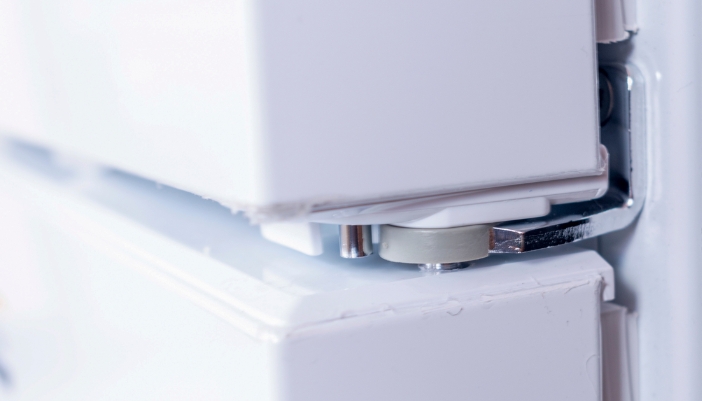
When it comes to appliances, a zero clearance door refers to the door and hinge design that requires minimal side clearance when the door is opened. Typically, the doors and their hinges extend beyond the side of the appliance when opened; sometimes, you may even need several inches of space to accommodate the width of the appliance with its doors opened. The zero clearance hinge changes how the door moves.
Instead of swinging widely into the space next to the refrigerator, the hinge is designed to allow the door to open with very little additional room on either side. In some models, the door can open while sitting extremely close to an adjacent wall or cabinet. Meaning, that your refrigerator doesn’t really need its own personal bubble.
How it Differs from Traditional Doors
With a traditional appliance door, the amount of clearance you need can vary depending on brand, model, appliance type, door style, and hinge design. If you are in the market for a new refrigerator, definitely keep an eye on this.
Let’s say you have a 36” wide refrigerator opening in your kitchen. You might assume that you just need to confirm that the refrigerator is going to fit into that opening. Unfortunately, this isn’t necessarily true. The refrigerator may physically fit into the opening, but if the doors need several inches of clearance to swing open, you may have a problem (especially if it’s against a wall). If you’re not able to fully open the door, you’ll have trouble accessing drawers and certain shelves. Even if you could reach every drawer and shelf, do you really want to have to pay attention to the certain angle your refrigerator needs to be opened at? Zero clearance designs help to solve that problem by moving the space-saving action into the hinge itself.
Advantages of Zero Clearance
The biggest advantage I am sure you can guess: you don’t need to sacrifice as much space around the appliance. This means that you can potentially install a larger appliance without needing a larger kitchen. Next time I am in the market for a refrigerator, I will absolutely be looking into this feature. Right now, I have a 30” wide fridge, in a space that can accommodate 33” width, all because the refrigerator is next to a wall.
Even if you don’t have a smaller kitchen, or inconveniently placed walls, zero clearance appliances offer a more seamless look. Because these appliances can sit closer to surrounding cabinetry and walls, they can create a more streamlined, built-in appearance. This can be appealing if you’re going for a clean, modern, and commercial kitchen design.
Appliances with Zero Clearance Doors
You’ll most commonly hear about zero clearance when shopping for refrigerators, but the feature isn’t limited to one appliance category.
Refrigerators
As mentioned earlier in this blog, zero clearance was designed specifically for refrigeration due to their size and door swing, and several manufacturers have incorporated zero clearance (or similar) technology into select models.
LG has been putting a significant amount of time and attention into its zero clearance hinge technology, particularly their Counter Depth MAX™ Models. These models combine the zero clearance hinge with a thin door design, allowing for full door opening even in the tightest spaces.
Check out the below LG Models that feature the Zero Clearance Hinge:
LG 36” 23.7 Cu. Ft. PrintProof™ Stainless Steel Counter Depth MAX™ with Zero Clearance™ French Door
LG 36” 25.1 Cu. Ft. PrintProof™ Stainless Steel Counter Depth French Door Refrigerator
Over-the-Range Microwaves
There is another appliance that could benefit from a zero-clearance hinge, and thankfully Frigidaire has started to catch on that over-the-range microwaves, or OTRs, sometimes need to take up less space. They have OTRs designed to be space-conscious, allowing for more clearance than a traditional OTR. This can be incredibly useful when you’re working in a small kitchen where your OTR, cabinets, range, and surrounding walls are all competing for the same few inches.
Zero Clearance Installation Requirements
Remember, zero clearance does not mean zero clearance everywhere. The hinge and door may require very little space on the sides, but the appliance can still have other installation requirements:
Depending on the model, you may need clearance:
- Behind the appliance
- Above the appliance
- Around ventilation areas
- For water lines or electrical connections
- To fully remove drawers, shelves, or other components
- For proper leveling and installation
The exact requirements will always depend on the individual appliance, so this is one of the instances where actually reading the installation guide is worth your time. You’ll always want to measure more than just the opening itself. Measure the width, height, depth, surrounding cabinetry, nearby walls, and the path the appliance will take getting into your kitchen.
Because, yes, your refrigerator can technically fit into its final location and still not fit through the front door. Ask me how I know!
The Bottom Line
So, do you need a zero clearance door?
Not necessarily.
If your refrigerator has plenty of room on both sides and you have no problem opening the doors fully, a traditional hinge may work perfectly well for your kitchen. But, if you’re working with a tight space, installing a refrigerator next to a wall, designing a galley kitchen, or trying to get the most out of a smaller footprint, zero clearance hinges can be a useful feature.
The best part is that you’re not giving up storage to save space: you’re choosing an appliance that’s designed to use your existing space more efficiently. And sometimes, that extra inch or two really does make all the difference!
Stop by Hallock's if you’re unsure whether a zero clearance refrigerator or microwave will work in your kitchen. Our team can help you compare models, look at your available space, and figure out which features actually make sense for your home.
The goal isn’t just finding an appliance that fits your space, it’s finding one that fits your life and your kitchen.